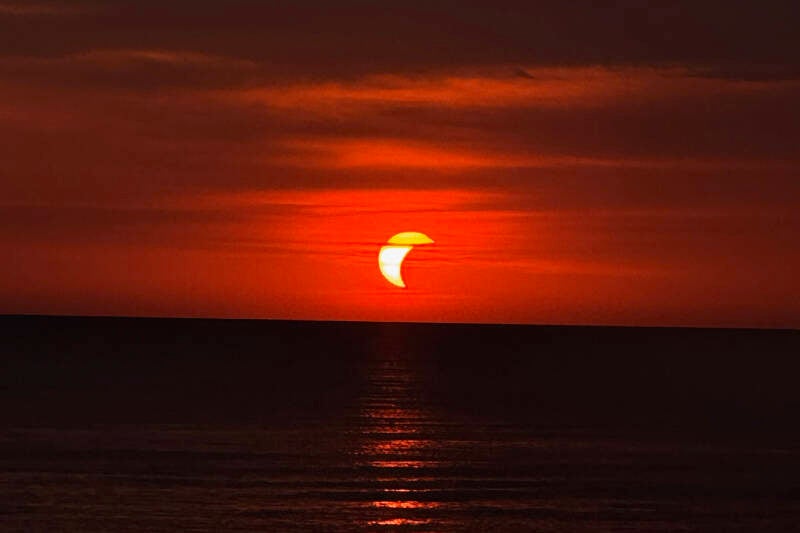
Solar Ecliples
A solar eclipse occurs when the Moon passes between the Earth and the Sun, temporarily blocking part or all of the Sun’s visible disc. This remarkable alignment is possible because, although the Sun is about 400 times larger than the Moon, it is also roughly 400 times farther away, making the two appear almost the same size in our sky.
During a total solar eclipse, the Moon completely covers the photosphere, revealing the normally hidden solar corona, while prominences may become visible around the edge of the lunar disc. Partial and annular eclipses occur when the alignment or apparent size of the Moon does not completely cover the Sun. Because totality can last only a few minutes from any given location, a total solar eclipse is one of the most spectacular and challenging astronomical events to observe and photograph.