Partial Solar Eclipse at Sunset – Sabaudia, 12 August 2026
Key Event Data
Event: Partial Solar Eclipse
Date: 12 August 2026
Location: Sabaudia, Lazio, Italy
Global event: Total Solar Eclipse
Local visibility: Partial eclipse
Beginning of the eclipse: approximately 19:33 local time
Sunset: approximately 20:11 local time
Setting: Western horizon over the Tyrrhenian Sea
Saros series: 126
Description
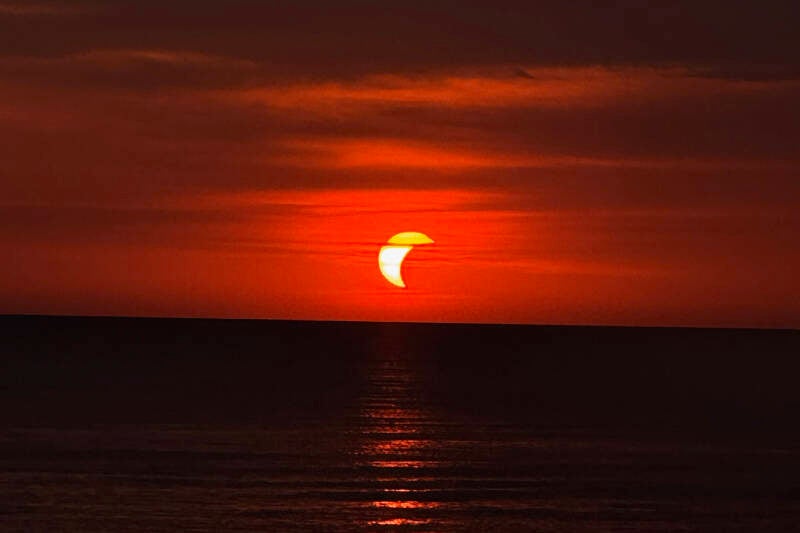
On the evening of 12 August 2026, a partial solar eclipse accompanied sunset over the Tyrrhenian Sea at Sabaudia, on the coast of Lazio in central Italy.
The photograph captures the eclipsed Sun shortly before it disappears below the horizon. The Moon's dark silhouette cuts into the solar disc, while horizontal layers of cloud partially obscure the remaining sunlight.
The Sun's exceptionally low altitude produces intense red and orange tones, with a narrow reflection stretching across the sea.
The result is an unusual combination of astronomical phenomena and coastal landscape, where the Sun, Moon, Earth's atmosphere and Mediterranean horizon all contribute to the scene.
An Eclipse Interrupted by the Horizon
From Sabaudia, the partial eclipse began at approximately 19:33, only 38 minutes before sunset.
As the Sun descended towards the Tyrrhenian Sea, the Moon progressively covered a larger portion of its disc.
However, the Sun reached the horizon before the eclipse could attain its maximum phase in the sky above Sabaudia.
The observation therefore ended naturally at sunset, with the solar disc still partially eclipsed.
The Moon in Front of the Sun
A solar eclipse occurs when the Moon passes between Earth and the Sun, temporarily obscuring part or all of the solar disc.
Although the Sun is approximately 400 times larger than the Moon, it is also roughly 400 times farther away, giving both objects similar apparent sizes in Earth's sky.
During this event, the Moon's silhouette progressively covered the Sun, creating the distinctive partially illuminated shape visible in the photograph.
The alignment involved three celestial bodies separated by enormous distances, yet appearing almost perfectly superimposed from the observer's perspective.
Clouds as Part of the Scene
The horizontal cloud layers crossing the Sun play an important role in the photograph.
They interrupt the remaining illuminated portion of the solar disc, creating separated bands of intense orange and red light.
At such a low altitude, sunlight travels through a much greater thickness of Earth's atmosphere. Shorter wavelengths are scattered more efficiently, allowing predominantly red and orange light to reach the observer.
The clouds further modify the scene by selectively obscuring and diffusing the remaining sunlight.
The resulting appearance is therefore shaped by both the precise geometry of the eclipse and the atmospheric conditions at sunset.
A Brief Alignment
Solar eclipses occur only during a New Moon, when the Sun and Moon occupy nearly the same direction in the sky.
However, because the Moon's orbit is inclined by approximately 5.1° relative to Earth's orbital plane, most New Moons do not produce eclipses.
An eclipse requires the Moon to pass sufficiently close to one of the points where its orbital plane intersects the ecliptic.
The alignment on 12 August 2026 belonged to Saros series 126, a sequence of related eclipses separated by approximately 18 years, 11 days and 8 hours.
From Sabaudia, the event was particularly brief because the Sun was already approaching the western horizon when the eclipse began.
Curiosities
The 12 August 2026 eclipse was part of a global event that produced totality along a narrow geographical path, while observers in Sabaudia experienced only a partial eclipse.
The Sun was already very low when the Moon began covering its disc, creating the unusual opportunity to observe an eclipsed sunset over the Mediterranean Sea.
The reddish colour of the Sun was not caused by the eclipse itself, but by atmospheric scattering associated with its low position above the horizon.
The combination of partial obscuration by the Moon, horizontal cloud layers and the sea horizon produced a distinctive shape that would not have appeared in the same way under different atmospheric or geographical conditions.
A Photograph of Three Worlds
This photograph brings together three celestial bodies: the Sun, the Moon and Earth.
The Sun, approximately 150 million kilometres away, provides the light illuminating the scene.
The Moon, roughly 384,000 kilometres from Earth, creates the dark silhouette cutting into the solar disc.
Earth provides the atmosphere responsible for the intense sunset colours, the clouds crossing the Sun and the Tyrrhenian horizon that ultimately ends the observation.
The photograph also records light that left the Sun approximately 8 minutes and 20 seconds before reaching Earth.
In a single frame, the image combines celestial geometry, atmospheric physics and the landscape of the Mediterranean coast.
On 12 August 2026, from the coast of Sabaudia, the Sun disappeared below the Tyrrhenian horizon before the Moon had finished crossing its disc — turning the final phase of the eclipse into an eclipsed sunset.