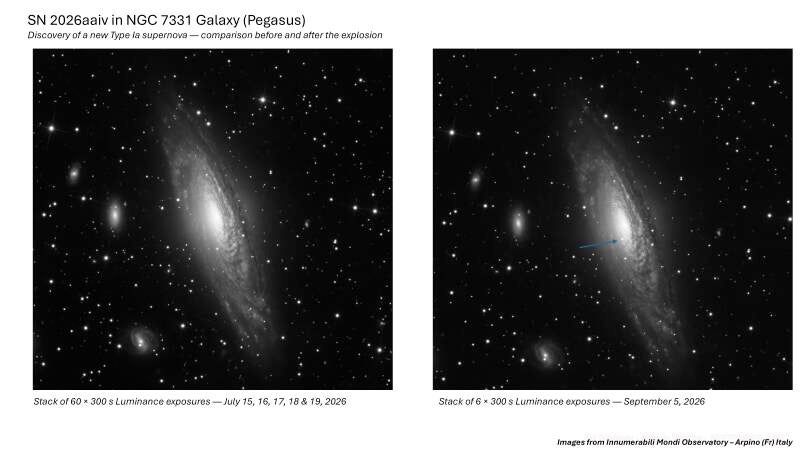
Supernovae
A supernova is the catastrophic explosion of a star, producing an enormous release of energy and briefly making the star extraordinarily luminous. At its peak, a single supernova can shine as brightly as billions of stars and, in some cases, rival the luminosity of its entire host galaxy.
Supernovae occur through two main physical mechanisms. In core-collapse supernovae, a massive star — typically born with more than about 8 times the mass of the Sun — eventually exhausts the nuclear fuel in its core. Once fusion can no longer provide enough pressure to oppose gravity, the core collapses in a fraction of a second. This collapse can leave behind an extremely compact neutron star or, for sufficiently massive cores, a black hole, while the outer layers of the star are violently expelled into space.
Type Ia supernovae follow a different evolutionary path. They involve a white dwarf in a binary stellar system that undergoes a thermonuclear disruption after conditions are reached that trigger runaway carbon and oxygen fusion. Unlike a core-collapse supernova, the white dwarf is generally destroyed rather than leaving behind a neutron star.
The most violent phases of a supernova explosion occur on timescales of only seconds, but what we observe in the night sky evolves much more slowly. After the explosion, the supernova typically brightens over days or weeks, reaches a maximum brightness, and then gradually fades over weeks to several months. Some supernovae can remain detectable with large telescopes for much longer.
Supernovae are also fundamental to the chemical evolution of the Universe. Their explosions eject newly formed elements into interstellar space, enriching the gas from which future generations of stars and planetary systems can form. Their expanding material can eventually develop into a supernova remnant, which may remain observable for thousands or tens of thousands of years.