Our astronomical instruments
You will find on this page the description of the astronomical instruments currently available in the Observatory. Most of the instruments were supplied over time by my trusted dealer Artesky.
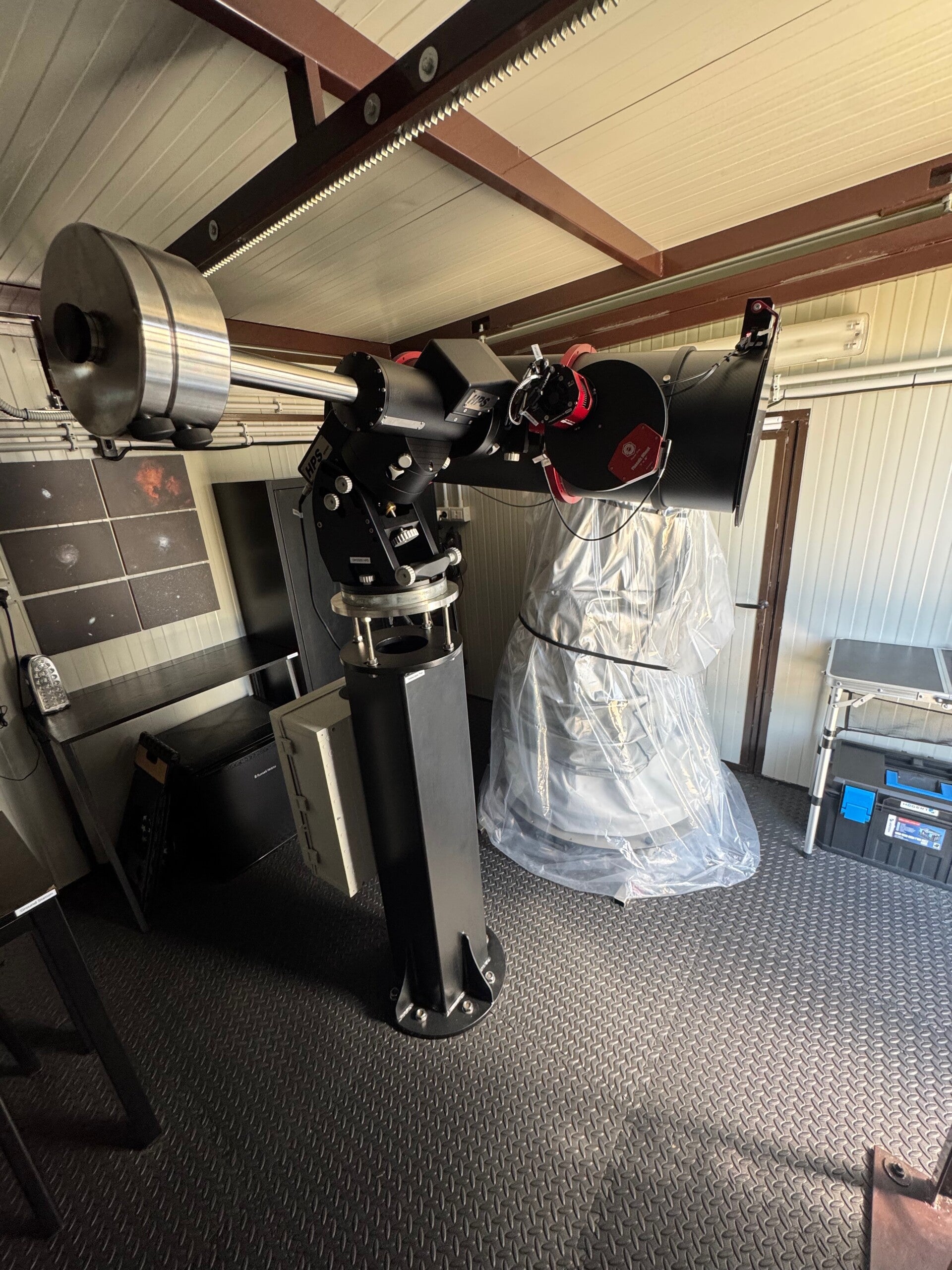
Newton Artec 250E 10'' (Medium-field Deep Sky imaging)
The main instrument mounted on the 10Micron GM2000 HPS II robotic mount is the sophisticated Artec 250E f/4.5 Newtonian astrograph, featuring a 250 mm (10-inch) aperture and a focal length of 1,140 mm, including the effect of the 1.14× coma corrector.
This is a high-quality astrograph used exclusively for deep-sky astrophotography, targeting very distant and often extremely faint astronomical objects. The imaging system is based on a cooled Player One Poseidon-M Pro monochrome camera.
The medium focal length of the optical tube, combined with the camera's APS-C CMOS sensor and 3.76 μm pixels, provides a field of view of approximately 1.18° × 0.78° and an image scale of 0.68 arcsec/pixel.
Focusing is performed by a Pegasus Astro Prodigy Microfocuser 3". The imaging system also includes a Player One Phoenix 7 × 2" filter wheel equipped with Antlia 2" LRGB broadband filters and Antlia 3 nm SHO narrowband filters, the latter mainly dedicated to imaging emission nebulae.
A 320 mm Wanderer Astro V4 PRO flat panel allows automatic flat-field images to be acquired and also closes the optical tube when it is not in use, helping to prevent dust and small animals from entering it.
The optical tube and all its equipment are carried by a 10Micron GM2000 HPS II COMBI robotic German equatorial mount. Thanks to its extremely high-precision mechanics and absolute encoders on both axes, the mount can accurately point to and track astronomical objects without the need for a separate guiding system.
The mount is installed on a 20 × 20 × 103 cm square-section steel column with 4 mm thick walls. The column is hot-dip galvanized and finished with a matt black textured coating to minimize reflections. Four reinforcing fins, each 30 cm high and 5 mm thick, are welded to the column and its base and are specifically designed to increase rigidity and minimize vibrations.
The base and top plates of the column, measuring 38 cm and 28 cm in diameter respectively and both 15 mm thick, are welded directly to the column.
Precision levelling of the mount is achieved through a stainless-steel plate secured to the upper plate of the column by four 12 mm threaded rods with a double-nut adjustment system. A second stainless-steel plate is mounted above it and interfaces with the black mounting plate supplied with the 10Micron mount.
The steel column and the two upper stainless-steel plates were manufactured by Meccanica Venditti in their precision mechanical workshop.
A dedicated Python script automatically retrieves real-time atmospheric pressure and temperature data from the AAG CloudWatcher Solo and sends them to the 10Micron robotic mount, allowing it to apply the atmospheric refraction corrections required for accurate sky tracking.
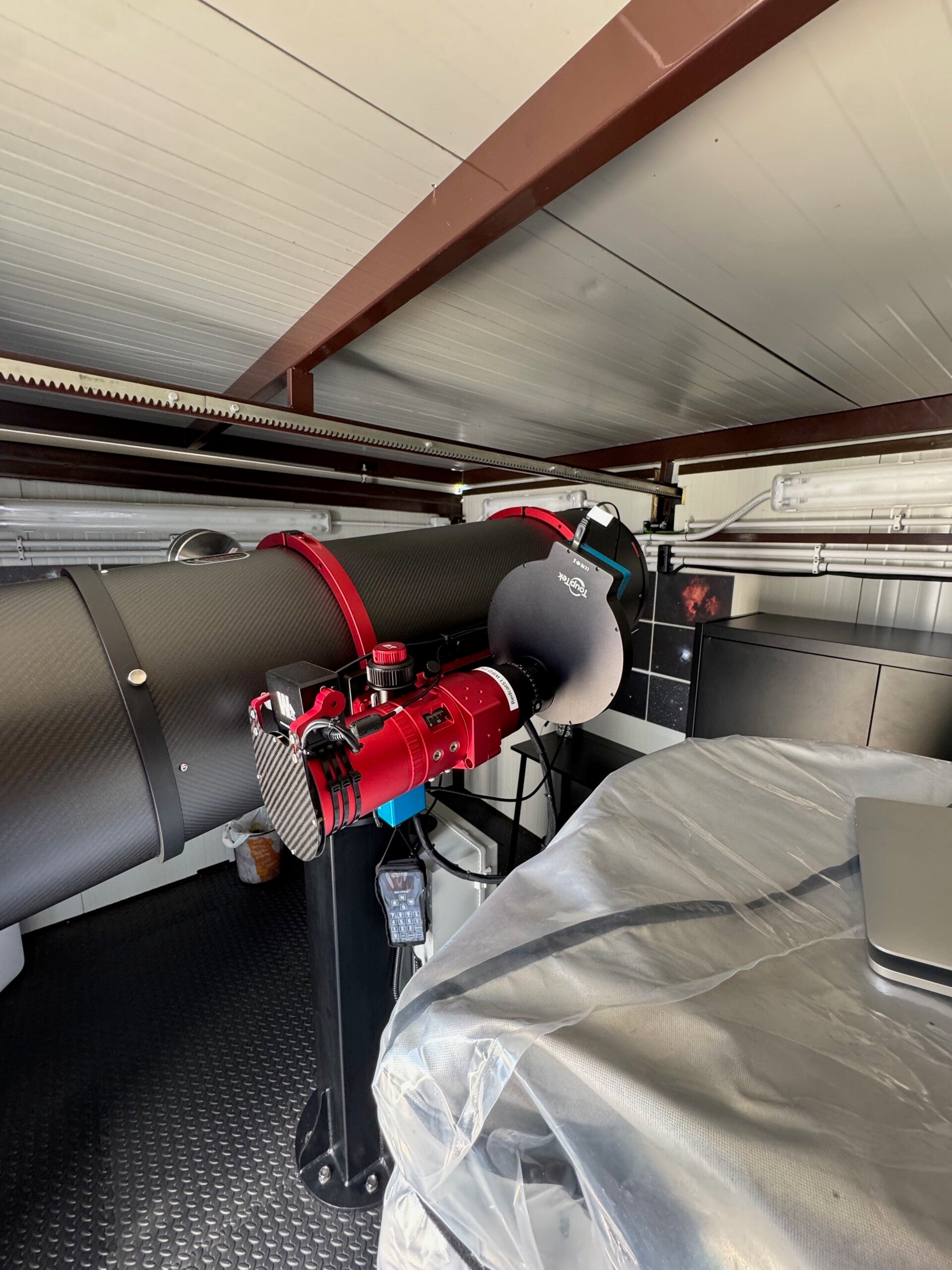
Apochromatic Refractor Redcat 51 (Large-field Deep Sky imaging)
This compact 51 mm aperture apochromatic refractor, manufactured by William Optics and featuring an innovative Petzval optical design, provides sharp, high-contrast images with minimal chromatic aberration.
Its short 250 mm focal length, combined with the APS-C sensor of the cooled Touptek 571C colour astronomical camera, provides a wide field of view of approximately 5.4° × 3.5° and an image scale of 3.12 arcsec/pixel. These characteristics make the system particularly suitable for imaging very large deep-sky objects and extended nebulae.
The optical tube is mounted using dedicated clamps directly onto the upper Losmandy dovetail bar of the Artec 250E Newtonian, which is carried by the high-precision 10Micron GM2000 HPS II COMBI robotic mount.
The imaging system also includes a Touptek 7 × 2" electronic filter wheel equipped with 2" Optolong broadband and 3 nm narrowband filters, allowing the most suitable filter to be selected according to the target and imaging conditions.
An 80 mm Wanderer Astro V4 PRO flat panel allows automatic flat-field images to be acquired after each imaging session, helping to correct variations caused by dust particles and other imperfections in the optical path.

GoTo Dobson Flextube 16'' (Visual observation & Planetary imaging)
This telescope is mainly intended for visual observation and planetary imaging. Although deep-sky astrophotography certainly reveals extraordinary details and colours that are invisible to the human eye, visual observation remains, for me, one of the most exciting experiences in amateur astronomy.
Just think about what it means to observe a distant astronomical object directly through an eyepiece: because of the time required for its light to reach us, you are literally looking into the past.
The instrument is a Sky-Watcher Skyliner Flextube Dobsonian f/4.4, featuring a large 406 mm (16-inch) aperture and a focal length of 1,800 mm. The Dobsonian alt-azimuth mount is motorized on both axes, allowing astronomical objects to be automatically located and tracked.
A Sky-Watcher GPS module provides the SynScan system with real-time date, time and precise geographical coordinates, simplifying the setup procedure before each observing session. The system is powered by a RoyPow power bank (86 Wh, 30 W).
The telescope is mounted on a stainless-steel trolley running on rails, allowing it to be easily moved from inside the Observatory onto the dedicated external platform. Once positioned on the external concrete platform, the Flextube structure can be fully extended to over 2 m, raising the secondary mirror and focuser assembly to its observing position and allowing the telescope to move freely in all directions.
The trolley-and-rail system was designed by my father-in-law, Antonio Di Folco, and me, and manufactured by Meccanica Venditti.
A raised stainless-steel structure is anchored to the external concrete platform, allowing the telescope to be used comfortably and safely. This structure was also designed by Antonio Di Folco and me and was built by us entirely by hand.
For visual observation, the available eyepieces include an Auriga 38 mm 70° 2", an Explore Scientific 24 mm 82° 2", Baader Morpheus 17.5 mm, 12.5 mm and 9 mm 76° eyepieces with dual 1.25"/2" barrels, a Pentax XW 7 mm 70° 1.25", and an SVBONY 12.5 mm illuminated-reticle eyepiece. The equipment also includes a Celestron X-CEL LX 3× Barlow lens.
The available filters include Baader Neodymium Moon & Skyglow with IR-Cut and UHC-S/L-Booster filters (1.25"), Baader Variable Polarizing filters (1.25" and 2"), and Neewer Red, Orange, Yellow, Green and Blue planetary filters (1.25").
With the available eyepieces, the 16" Dobsonian provides magnifications from 47× to 257×, extending up to 771× with the 3× Barlow. In practice, atmospheric seeing will usually limit useful magnification to about 200–400×, with higher magnifications requiring exceptionally stable conditions.
The raised stainless-steel platform provides easy and comfortable access to the eyepiece, making it ideal for relaxing visual observing sessions as well as planetary imaging.
Planetary imaging is performed using an Omegon veLOX 290 C colour camera.

ALL SKY camera (180° Sky view)
The ALL SKY camera, visible on the left in the photo and supplied by Astrottica, is installed on the pole in the south-eastern corner of the Observatory and provides a 180° view of the sky, 24 hours a day.
It is equipped with a ZWO ASI178MC colour camera, a 1.25 mm f/2 fisheye lens with a 185° field of view, providing sharp and high-contrast images right to the edges, and a protective dome with UV/IR-cut treatment to minimize reflections and reduce overheating during the hottest hours of the day.
The heart of the system is located at the base of the unit and includes a Raspberry Pi 5, an internal anti-condensation system, an external temperature and humidity sensor, and an automatically controlled cooling fan.
In addition to providing continuous visual monitoring of sky and weather conditions, the AllSky camera is also useful for calibrating the CloudWatcher weather station.
At night, the AllSky camera automatically captures an image every 60 seconds, making it possible to record transient events such as meteors and even the Northern Lights, which can occasionally be visible at our latitude.
A dedicated Python script running directly on the Raspberry Pi automatically analyses the images acquired during the night in order to detect possible meteor trails. The software scans the frames, applies geometric and brightness filters, excludes unsuitable areas of the image, and identifies linear features compatible with meteors. Candidate events are then saved as annotated images and reported automatically, allowing the previous night's sky to be reviewed without manually inspecting hundreds of individual frames.
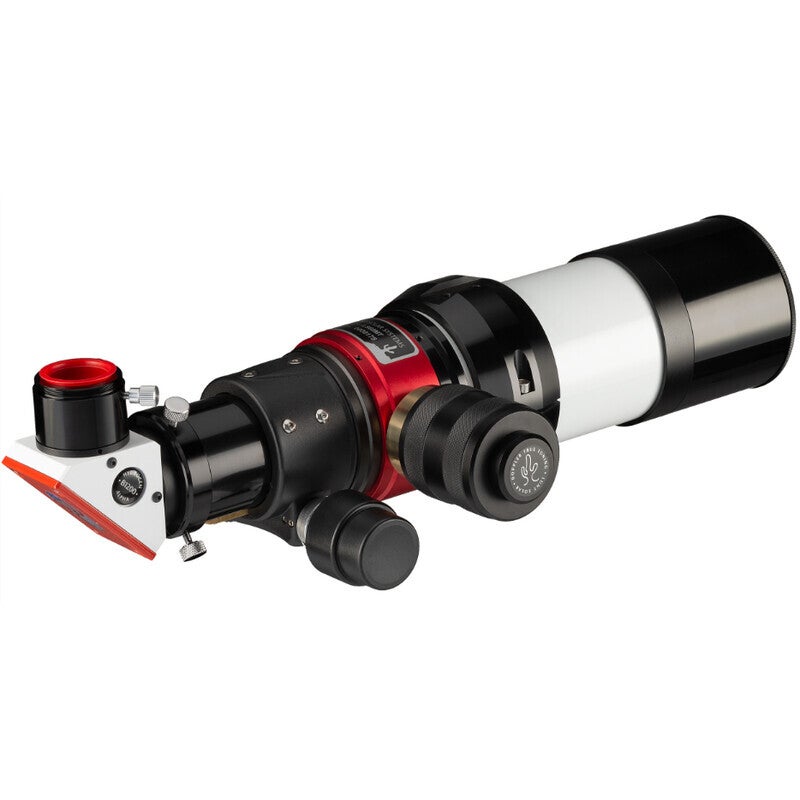
Lunt Solar Telescope
For solar observation, the observatory uses a Lunt LS60MT Ha B1200 Allround, a modular 70/420 mm ED doublet apochromatic refractor (APO) mounted on a Sky-Watcher Star Adventurer 2i tracking mount.
In H-alpha (656.28 nm), the Lunt system allows observation of the Sun’s chromosphere, revealing prominences, filaments, active regions and other rapidly evolving structures of solar activity.
By removing the H-alpha module, the telescope can also be used for white-light observation and imaging with a Baader 2" Cool-Ceramic Herschel Prism (Photographic Version). The prism is supplied with five 2" filters: a Baader Solar Continuum 7.5 nm filter and four Neutral Density filters (ND 3.0, ND 1.8, ND 0.9 and ND 0.6). This configuration reveals the photosphere, including sunspots, umbrae and penumbrae, faculae and, under good seeing conditions, solar granulation.
The two observing modes are complementary, providing views of two different layers of our nearest star: the photosphere in white light and the chromosphere in H-alpha.

Reflex on the star-tracker (Moon, Night Landscape & Milky Way)
The Observatory is also equipped with a Canon EOS 6D Mark II DSLR featuring a full-frame sensor. The camera is used with a range of lenses covering focal lengths from 14 mm for extremely wide fields to 300 mm for smaller areas of the sky: a Samyang 14 mm f/2.8, a Canon EF 50 mm f/1.8 STM, and a Canon EF 75–300 mm f/4–5.6 III telephoto zoom.
The camera is mounted on a Sky-Watcher Star Adventurer 2i star tracker, equipped with a SIRUI KH-20 ball head. The entire system is supported by a stable Artesky 36 mm carbon-fibre tripod.
By compensating for the apparent motion of the night sky caused by the Earth's rotation, the star tracker allows significantly longer exposure times while keeping the stars sharp, making it possible to collect much more light for high-quality night-sky photography.
This setup is particularly suitable for photographing the Moon, wide-field landscapes of the Milky Way, and large areas of the night sky, including entire constellations.