Messier 101 – The Pinwheel Galaxy
Key Scientific Data
Object type: Face-on spiral galaxy – SAB(rs)cd
Constellation: Ursa Major
Other designations: NGC 5457, UGC 8981, PGC 50063, Pinwheel Galaxy
Distance from Earth: approximately 21 million light-years
Diameter: approximately 170,000 light-years
Apparent size: approximately 29 × 27 arcminutes
Apparent magnitude: approximately 7.9
Orientation: almost face-on, inclination approximately 18°
Right Ascension: 14h 03m 13s
Declination: +54° 21′
Discovered by: Pierre Méchain, 1781
Estimated number of stars: hundreds of billions
Notable feature: strongly asymmetric spiral structure
Light-travel time: approximately 21 million years
Description
Messier 101, better known as the Pinwheel Galaxy, is a magnificent spiral galaxy located approximately 21 million light-years from Earth in the constellation Ursa Major.
With a diameter of roughly 170,000 light-years, M101 is considerably larger than the Milky Way. Because we see it almost face-on, its vast disc and intricate spiral pattern are displayed particularly well.
Unlike the remarkably regular appearance of galaxies such as M51, M101 is noticeably asymmetric. Its spiral arms are uneven in length, brightness and shape, giving the galaxy a more complex and less orderly appearance. This distortion is probably related to past gravitational interactions with smaller neighbouring galaxies.
Its relatively small central region is surrounded by an enormous disc populated by young blue stars, dark lanes of interstellar dust and numerous luminous nebular complexes.
An Asymmetric Giant
One of the most distinctive characteristics of M101 is the contrast between its enormous size and its relatively delicate, irregular structure.
The galaxy's gravitational environment is thought to have played an important role in shaping this appearance. M101 is accompanied by several smaller galaxies, and past encounters with its neighbours may have pulled and distorted parts of its disc.
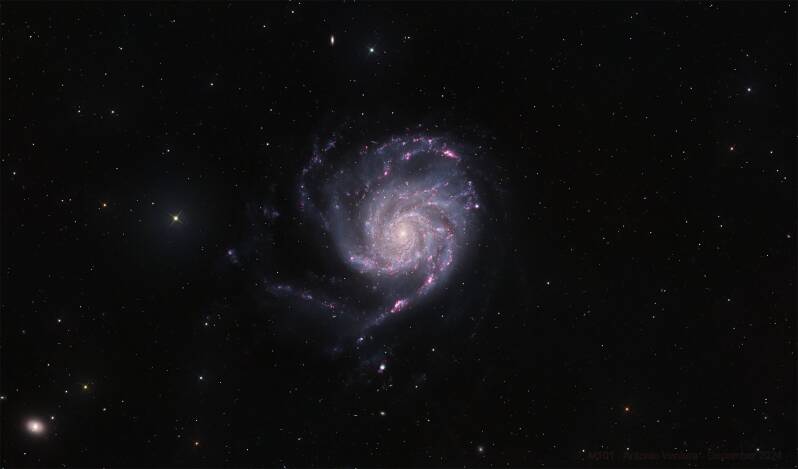
The result is clearly visible in this photograph: the spiral arms do not form a perfectly symmetrical pattern around the nucleus. Some extend much farther than others, while sections of the outer disc appear fragmented and stretched into faint structures.
This makes M101 an excellent example of how galaxies are not isolated objects. Even encounters that do not result in a merger can leave visible traces in their structure for hundreds of millions of years.
Giant Nebulae in Another Galaxy
One of the most remarkable features of M101 is the number of enormous nebular complexes embedded within its spiral arms.
Several are sufficiently large and bright to have their own NGC catalogue numbers, including NGC 5461, NGC 5462, NGC 5455 and NGC 5471. They are not separate galaxies but immense regions physically located inside M101.
Among the most impressive is NGC 5471, situated far out in one of the galaxy's outer arms. It is an exceptionally luminous complex containing multiple sites of massive star formation.
In this image, the additional H-alpha data make these structures particularly prominent. They appear as the numerous pink and reddish knots distributed along the spiral pattern, providing a striking map of where massive young stars are influencing the gas around them.
The scale is difficult to appreciate at first glance: many of the tiny coloured patches visible in the photograph are actually vast structures hundreds or even thousands of light-years across.
What the Colours Reveal
The colour differences across M101 trace several distinct components of the galaxy.
The bluish spiral arms contain large populations of young, hot stars, while the warmer central region is dominated by older stellar populations. The pink-red knots highlighted by the H-alpha data correspond to ionised gas associated with the galaxy's major nebular complexes.
Dark lanes and patches cutting through the brighter regions are clouds of interstellar dust, absorbing part of the light coming from stars behind them.
Together, these structures turn the almost face-on disc of M101 into a remarkably detailed view of the internal anatomy of a spiral galaxy.
A Rich Extragalactic Field
M101 dominates this photograph, but the surrounding field contains several other galaxies.
Most conspicuous is the bright elliptical-looking object in the lower-left corner of the image. Other much smaller and fainter galaxies can be found scattered throughout the background, including a clearly elongated edge-on system near the upper part of the frame.
These objects lie at different distances and are seen in projection around M101, while the sharp individual points of light across the image are predominantly foreground stars within our own Milky Way.
The deep field therefore creates several layers of perspective: nearby stars, the enormous disc of M101 about 21 million light-years away, and other galaxies appearing beyond or around it.
This is particularly striking because M101's faint outer arms occupy such a large part of the frame that the boundary between the galaxy and the apparently empty background gradually becomes difficult to define.
Curiosities
M101 was discovered in 1781 by Pierre Méchain, a close collaborator of Charles Messier, who subsequently included it as the 101st object in his famous catalogue.
Its almost face-on orientation makes it one of the finest galaxies for studying spiral structure, but paradoxically it can be a difficult visual target. Although its total apparent magnitude is relatively bright, that light is spread over a large area, giving M101 a low surface brightness.
M101 has also hosted several observed supernovae. The most recent spectacular example was SN 2023ixf, discovered in May 2023. It was a Type II supernova produced by the core collapse of a massive star and became one of the closest and most intensively studied supernovae of recent years.
Because M101 is relatively nearby, astronomers were even able to investigate archival observations of the region where the star exploded, providing valuable information about its progenitor before the supernova occurred.
Looking Back in Time
The light recorded in this photograph has travelled for approximately 21 million years before reaching Earth.
We therefore see M101 not as it exists today, but as it appeared around 21 million years ago.
When these photons left the Pinwheel Galaxy, Earth was in the early Miocene epoch. Our planet already hosted recognisable groups of mammals and birds, but the human lineage as we know it was still millions of years in the future.
During that immense interval, the light crossed intergalactic space carrying information about M101's stars, dust clouds and enormous nebular complexes.
A tiny fraction of those photons eventually reached Earth and was collected by the telescope to create this image.
Every structure visible in M101 is therefore a view not only across 21 million light-years of space, but also 21 million years into the past.
Image Data
Total integration time: 27h 38m 40s
Integration by filter:
-
L-Pro: 10h 47m 40s
-
Red: 4h 5m
-
Green: 4h 41m
-
Blue: 4h 15m
-
Hα: 3h 50m (23 × 600")
Equipment:
-
Telescope: Artesky ARTEC 250 Pro
-
Camera: ToupTek ATR2600M
-
Mount: 10Micron GM2000 HPS II
-
Filters: Optolong Blue 2", Optolong Green 2", Optolong H-Alpha 3nm 2", Optolong L-Pro, Optolong Red 2"
-
Accessories: Pegasus Astro Prodigy Microfocuser, WandererAstro WandererBox Pro V3, ZWO EFW 7×2"
-
Software: Adobe Photoshop, Pleiades Astrophoto PixInsight, Stefan Berg Nighttime Imaging 'N' Astronomy (N.I.N.A. / NINA)
For further details and the full-resolution image, visit AstroBin:
View M101 – The Pinwheel Galaxy on AstroBin